When Fast Becomes Dangerous: The Diminishing Returns of Speed
Urgency – poorly disguised incompetence. Constant crisis, speed, the ‘rush’. Warning signs of imminent failure, not strength and success.

“FIRE FIRE FIRE” said three times avoiding ambiguity. My breakfast tray found its way to the floor behind me.
It had been a long night – the usual choice of airline ‘inspired’ omelette and mushrooms was my breakfast, starting to pick me up for the last 90 minutes of flight. The rapid loud beeping of the cockpit door was not a welcome distraction from the quiet hum of the avionics fans and the comforting consistent woosh of the air over the cockpit windows. The sun starting to pierce our tired eyes.
The interruption jerked us into action. Our contingency plans, diligently formed but rarely used, were about to be put to the test. This was to be my first real emergency in an airliner. The time I find out what my I’m really made of.
The carefully honed skills, the psychology – human factors – that had been taught to me led me through the complex checklist, the technical skills and coordination with my colleagues. An electrical fire in the overhead bin had caught the attention of the circa 220 people entrusting their lives to us.
The fire proved particularly stubborn leading to an easy decision. It’s better to be on the ground wishing you were in the sky than in the sky wishing you were on the ground. This was one of those moments where we were in the sky wishing we were on the ground.
Expertise is often assisted by luck and as fate would have it this day, luck was on our side. A major international airport was a few miles off our left side. Eight minutes later we were touching down.
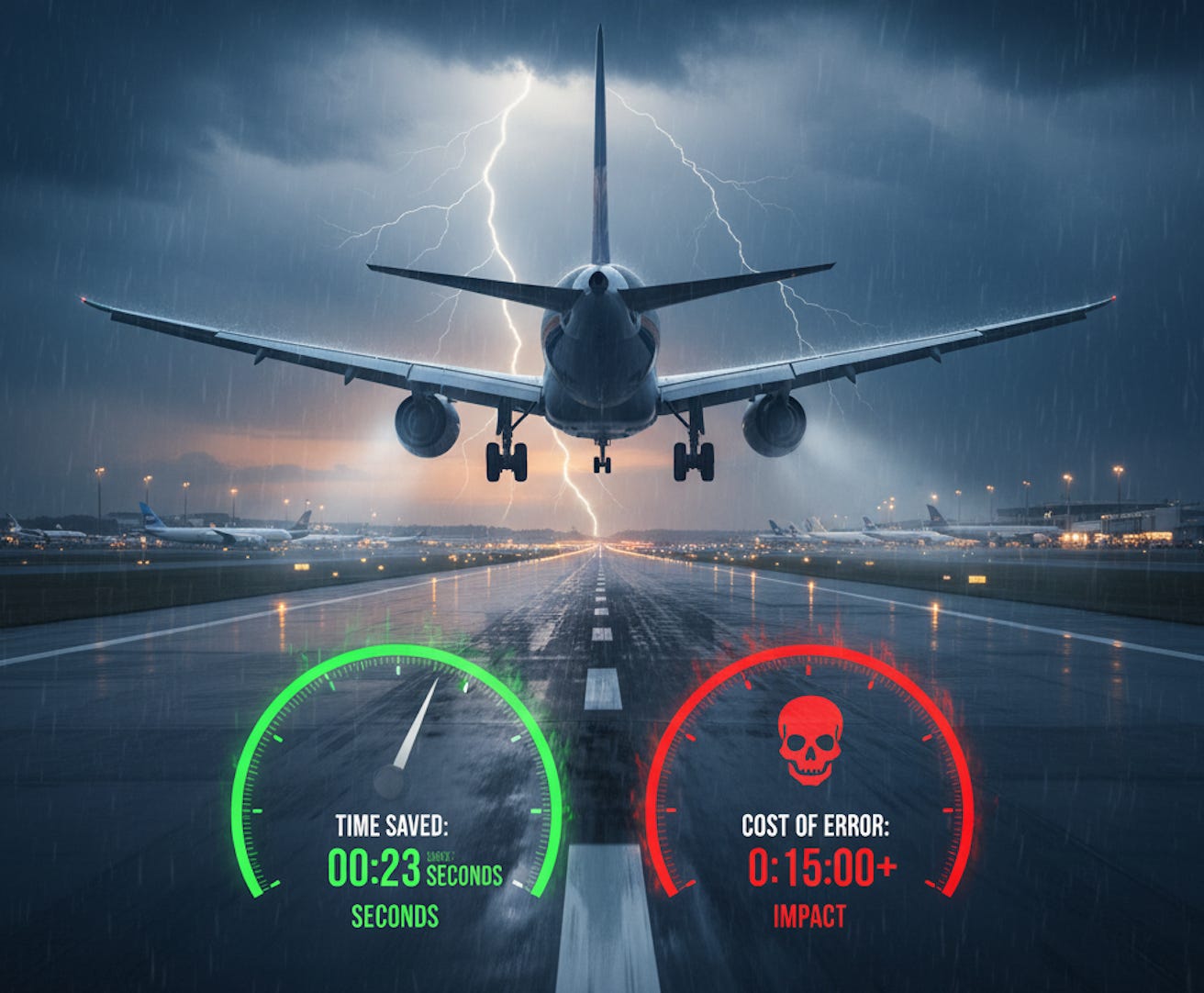
It can be easy to think that we rushed, sped or otherwise went as fast as we could, and for part of the scenario, you think right, but there’s that final moment when you’re coming down the approach. To anyone looking on, our approach and landing looked like any other. It was slow, considered and careful.
Words from a close friend of mine, an ex-Special Forces helicopter pilot rang true:
“When the tracer bullets fly past the cab (a colloquial term for a military helicopter), slow it down, because if you don’t and you get it wrong, you have to do it all again and they won’t miss you next time”.
Had we rushed, our time saving would be maybe 30 seconds, but if we got it wrong and couldn’t safely land, it’d have taken an extra 10 minutes.
The Physics of Going Nowhere Faster
Speed has diminishing returns, and the math is brutal.
Take your car. Going from 30 to 40 mph is a 33% increase in speed. Going from 60 to 70 mph? Only 17%. But the energy required to maintain that higher speed, and the damage if something goes wrong, increases exponentially.
In aviation, this principle becomes life-or-death. A bird strike at 180 knots versus 250 knots isn’t just “a little worse” – it’s much worse. Your margins for error shrink dramatically while your actual time savings remain trivial.
I’ve watched pilots push approach speeds trying to save literally seconds, only to create unstable approaches that require go-arounds. The result? They end up 15 minutes later than if they’d just flown normally.
Why Smart People Keep Pushing Faster
Speed Feels Productive
There’s something intoxicating about velocity. Moving fast feels like progress, like competence, like you’re winning. But feeling productive and being effective are different things.
External Pressure
Schedules, expectations, impatient stakeholders. The pressure to go faster comes from everywhere. But here’s what most people miss: the pressure usually isn’t about the few seconds you might save—it’s about being seen as someone who “gets things done.”
The Competence Trap
Skilled people often push speed limits because they can handle it. “I’m good enough to manage this pace” becomes the justification. But competence isn’t the issue—it’s whether the marginal speed gain is worth the exponential risk increase.
The Ego Boost
In fasted-paced and high-pressure environments, speed feels like power and control. It feeds the ego of importance. And, as highlighted in my previous article on ego, it can be ones undoing.
The Hidden Costs of Excessive Speed
Decision-Making Degrades
When you’re operating at the edge of your speed envelope, your brain shifts resources from thinking to reacting. Complex decisions get simplified. Nuance disappears. You start missing things that would be obvious at a sustainable pace.
Safety Margins Evaporate
Every system has buffers built in; time, space, energy, attention. Speed exponentially consumes these buffers. At some point, you’re operating with no margin for the unexpected. And the unexpected always shows up.
Team Stress Compounds
Individual stress is manageable. Team stress under time pressure creates cascading problems. Communication suffers, people make assumptions, coordination breaks down. The whole system becomes brittle.
Quality Becomes Optional
When speed is the priority, everything else becomes negotiable. Details get skipped, double-checks get abandoned, “good enough” becomes good enough. Until it isn’t.
Business at the Speed of Stupid
The aviation lessons translate directly to business and life, where speed addiction might be even worse.
Companies rush product launches to beat competitors, only to spend months fixing quality issues that could have been caught with slightly more time. Teams work 80-hour weeks to meet arbitrary deadlines, burning out key people and ultimately slowing progress for months.
The most damaging part? Speed becomes a cultural value. Organizations start rewarding velocity over results, creating systems that mistake motion for progress.
Finding Your Efficient Speed
Know Your Threshold
Every system has an optimal operating speed. Cars get better fuel economy at 55 mph than 75 mph. Aircraft have specific speeds for maximum efficiency. Teams have sustainable paces that maximize long-term output.
The question isn’t whether you can go faster – it’s whether you should.
Calculate Real Time Savings
Before pushing the pace, do the math. How much time are you actually saving? Is it minutes or seconds? Compare that to the increased risk, stress, and potential for errors that will cost far more time to fix.
Most speed pushes save trivial amounts of time while creating significant downstream costs.
Build in Margins
Instead of operating at maximum speed, build buffers into your timeline. Leave space for the unexpected, for quality checks, for the small delays that always emerge.
Margins aren’t waste—they’re insurance against the exponential costs of things going wrong.
Communicate Speed Limits
When stakeholders push for more speed, help them understand the tradeoffs. “We can go faster, but here’s what we’ll sacrifice and here’s the actual time we’ll save.” Most reasonable people prefer sustainable progress to unsustainable sprints.
The Paradox of Slowing Down
Sometimes the fastest way to your destination is knowing when not to go faster.
Skilled pilots and oddly, racing drivers, are masters of this paradox. A saying used in both professions – Slow is smooth, smooth is fast – is often cited. Taking a little extra time to expertly exercise your judgement allows you to move that bit faster.
You can notice this when driving. The driver that races away from one fresh green light to the next red light gets to their destination slower than the driver who quietly cruises towards the red light that turns green as they cruise past the rushing fool.
The most successful people I know aren’t the fastest, they’re the ones who operate at sustainable speeds with appropriate margins. They get to their destinations consistently, with energy left for the next challenge.
Your next meeting doesn’t need to be a sprint. Your project doesn’t need to be a death march. Your decision doesn’t need to be instantaneous.
Sometimes the most productive thing you can do is slow down enough to see where you’re actually going.
The destination will still be there when you arrive safely.